


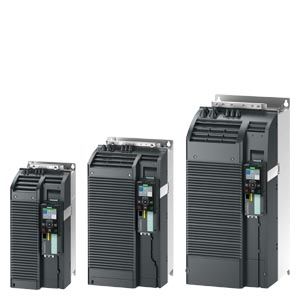
The SINAMICS G120 frequency inverter is designed to provide precise and cost-effective speed/torque control of three-phase motors. With different device versions (frame sizes FSA to FSGX) in a power range from 0.37 kW to 250 kW (0.5 hp to 400 hp), it is suitable for a wide variety of drive solutions.  Example: SINAMICS G120, frame sizes FSA, FSB and FSC; each with Power Module, CU240E‑2 F Control Unit and Basic Operator Panel BOP-2  Example: SINAMICS G120, frame sizes FSD, FSE and FSF; each with Power Module, CU240E‑2 F Control Unit and Intelligent Operator Panel IOP  Example: SINAMICS G120, frame size FSGX; with Power Module, CU240E‑2 F Control Unit and Basic Operator Panel BOP-2 Operator-friendly designSINAMICS G120 is a modular inverter system that essentially comprises two function units:
The Control Unit controls and monitors the Power Module and the connected motor using several different closed-loop control types that can be selected. It supports communication with a local or central controller and monitoring devices. The Power Module supplies the motor in the power range 0.37 kW to 250 kW (0.5 hp to 400 hp). It features state-of-the-art IGBT technology with pulse-width-modulated motor voltage and selectable pulse frequency. Comprehensive protection functions provide a high degree of protection for the Power Module and the motor. The Control Units can be combined with the following Power Modules:
Safety IntegratedSINAMICS G120 standard inverters are available in different versions for safety-related applications. The PM240‑2 and PM250 Power Modules are already designed for Safety Integrated. PM240 Power Modules, frame size FSGX (i.e. 160 kW/250 hp and higher) are approved only for the Basic Safety functions (STO, SS1, and SBC). A drive can be combined with a Control Unit with safety functions (see overview) in order to create a Safety Integrated drive. The availability of Safety Integrated functions depends on the type of Control Unit.
1) The SBC function can be utilized only if a Safe Brake Relay is installed. 2) SSM possible only for CU240E‑2 DP‑F / CU240E‑2 PN‑F Control Units with PROFIsafe. 3) With license for Extended Safety functions. Basic Safety functions (certified according to IEC 61508 SIL 2, and EN ISO 13849‑1 PL d and Category 3)
Extended Safety functions (certified according to IEC 61508 SIL 2 and EN ISO 13849‑1 PL d and Category 3)
Basic Safety and Extended Safety functions can be activated via PROFIsafe or by means of the safety inputs. None of the safety functions require a motor encoder and they are thus cheaper and easier to implement. Existing systems in particular can be simply updated with safety technology without the need to change the motor or mechanical system. The Safe Torque Off (STO) function can be used without restriction for all applications. The SS1, SLS, SSM and SDI functions are only permissible for applications where the load can never accelerate when the inverter is switched off. They are therefore not permitted for applications involving pull-through loads such as hoisting gear and unwinders. Additional information is provided in chapter Highlights, section Safety Integrated. Efficient Infeed TechnologyThe innovative Efficient Infeed Technology is employed in PM250 Power Modules. This technology allows the energy produced by motors operating in generator mode connected to standard inverters to be fed back into the supply system. For control cabinets, an additional temperature rise can be avoided and the amount of space required can be reduced due to the fact that components such as braking resistors, braking choppers and line reactors can be eliminated. Further, wiring and engineering costs are significantly reduced. At the same time, energy consumption can be reduced and ongoing operating costs noticeably reduced. Additional information is provided in chapter Highlights, section Efficient Infeed Technology. Innovative cooling concept and varnishing of electronic modulesThe new cooling system and varnishing of the electronic modules significantly increases the service life or useful life of the device.
Energy efficiencyIntegrated technologies help when optimizing the energy usage of the plant or system referred to the particular application:
Additional information is provided in chapter Highlights, section Energy efficiency. |
|||||||||||||||||||||||||||||||||||||||||||||||||||||||||||||||
| Каталог 2018 | Каталог 2017 | Каталог 2016 | Каталог 2015 | Каталог 2014 | Каталог 2013 | Каталог 2012 | Сертификат | Контакты | Карта сайта | Поиск |