


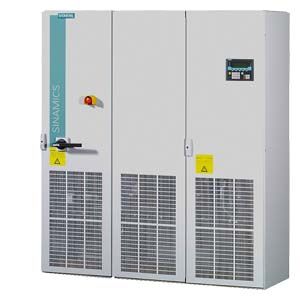
Derating dataSINAMICS S150 converter cabinet units and the associated system components are rated for an ambient temperature of 40 °C and installation altitudes up to 2000 m above sea level. At ambient temperatures > 40 °C, the output current must be reduced. Ambient temperatures above 50 °C are not permissible. At installation altitudes > 2000 m above sea level, it must be taken into account that the air pressure, and therefore air density, decreases as the height increases. As a consequence, the cooling efficiency and the insulation capacity of the air also decrease. Due to the reduced cooling efficiency, it is necessary, on the one hand, to reduce the ambient temperature and on the other hand, to lower heat loss in the converter cabinet unit by reducing the output current, whereby ambient temperatures lower than 40 °C may be offset to compensate. The following table lists the permissible output currents depending on the installation altitude and ambient temperature for the various degrees of protection. The specified values already include a permitted compensation in respect of installation altitude and ambient temperatures < 40 °C (temperature at the air intake of the converter cabinet unit). The values apply under the precondition that the cooling air flow stated in the technical specifications is ensured by the way the devices are installed in the cabinet. As additional measure for installation altitudes from 2000 m up to 5000 m, an isolating transformer is required in order to reduce transient overvoltages according to EN 60664‑1. For additional information, please refer to the SINAMICS Low Voltage Engineering Manual. Current-derating factors for converter cabinet units depending on the ambient / air intake temperature, the installation altitude and the degree of protection
Current derating as a function of the pulse frequency To reduce motor noise or to increase output frequency, the pulse frequency can be increased relative to the factory setting (1.25 kHz or 2 kHz). When the pulse frequency is increased, the derating factor of the output current must be taken into account. This derating factor must be applied to the currents specified in the technical specifications. For additional information, please refer to the SINAMICS Low Voltage Engineering Manual. Derating factor of the output current depending on the pulse frequency for devices with a rated pulse frequency of 2 kHz
Derating factor of the output current depending on the pulse frequency for devices with a rated pulse frequency of 1.25 kHz
The following table lists the maximum achievable output frequency as a function of the pulse frequency:
Overload capabilityThe SINAMICS S150 converter cabinet units are equipped with an overload reserve to deal with breakaway torques, for example. If larger surge loads occur, this must be taken into account in the configuration. For drives with overload requirements, the appropriate base load current must, therefore, be used as a basis for the required load. The criterion for overload is that the drive is operated with its base load current before and after the overload occurs on the basis of a duty cycle duration of 300 s. Another precondition is that the frequency converter is operated at its factory-set pulse frequency at output frequencies >10 Hz. For temporary, periodic duty cycles with high variations of load within the duty cycle, the relevant sections of the SINAMICS Low Voltage Engineering Manual must be observed. The base-load current for a low overload IL is the basis for a duty cycle of 110 % for 60 s or 150 % for 10 s.  Low overload The base-load current IH for a high overload is based on a duty cycle of 150 % for 60 s or 160 % for 10 s.  High overload |
|||||||||||||||||||||||||||||||||||||||||||||||||||||||||||||||||||||||||||||||||||||||||||||||||||||||||||||||||||||||||||||||||||||||||||||||||||||||||||||||||||||||||||||||||||||||||||||||||||||||||||||||||||||||||||||||||||||||||||||||||||||||||||||||||||||||||||||||||||||||||||||||||||||||||||||||||||||||||||||||||||||||||||||||||||||||||||||||||||||||||||||||||||||||||||||||||||||||||||||||||||||||||||||||
| Каталог 2018 | Каталог 2017 | Каталог 2016 | Каталог 2015 | Каталог 2014 | Каталог 2013 | Каталог 2012 | Сертификат | Контакты | Карта сайта | Поиск |