


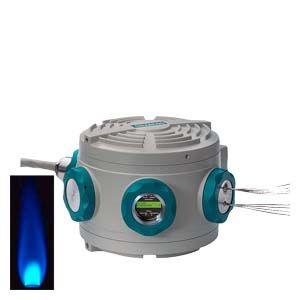
? Live injectionThe SITRANS CV has a two-stage injection system. Using a micro injection valve, a defined quantity of sample is first brought up to the carrier gas pressure. This eliminates the pressure-dependent error in the dosing quantity present with conventional systems. In the second stage, the sample is transferred to the column by a valveless micro injection system (live dosing). The result is an "active" injection. The injection volume can be varied time-controlled, and exactly matched to the column requirements. Valveless live column switchingBecause of the high dead volume of conventional valves, only the valveless version can be considered for a miniaturized system. In this case, the generation of differences in flow using several electronic pressure regulators at appropriate positions of the column setup causes a change in the flow directions. (The system operates according to the Wheatstone principle, but pneumatically.) The functions "Cut" and "Backflushing" can then be implemented free of dead volume. The column systemThe separation system consists of up to three separation columns connected in series. Micro TCDs or micro live circuits are installed in sequence ("inline") upstream and downstream of the individual columns. Three electronic pressure regulators supply the columns with carrier gas and carry out the switching functions (injection, backflushing and cut). By using narrow-bore capillary columns, the separation at high resolution is carried out within a much shorter time, approx. factor 2 to 3 compared to standard capillary columns. Electronic pressure regulatorsA high pressure stability together with rapid changing rates in the hPa range are required for precise and fast switching. This is achieved in the electronic pressure regulators by means of a piezo actuator. DetectorThe micro TCDs (silicon wafer technology) work on the principle of continuous measurement of the different thermal conductivities of the carrier gas and the components to be measured. The measurement can be carried out without falsification by avoiding catalytic effects on the heating wires and maintaining a constant flow velocity. This permits consistent in-line detection, i.e. without qualitative or quantitative losses of substances. ModulesThe standardized application modules generally feature live injection and live switching functions, detectors and separation columns.
ApplicationThe SITRANS CV is a storage product. Precalibration is carried out at the factory, using helium and argon (as the carrier gas) and a calibration gas. The measured components and switching functions (live injection, backflushing, cut) are saved in the GC. The calibration process itself should be performed during commissioning on-site. Measurements can be made within the following working ranges:
Table 1: Measured components and performance parameters for Pos. 8_0 (master setup, standard calorific value analysis in accordance with ISO 6976-1995) 1) Any oxygen or carbon monoxide present in the sample will be detected along with the nitrogen and, therefore, taken into account when the nitrogen concentration is determined. 2) Hexane+ = group(iso/n-hexane to iso/n-nonane) 3) Heptane+ = group(iso/n-hexane) and group(iso/n-heptane to iso/n-nonane) 4) Nonane+ = group(iso/n-hexane), group(iso/n-heptane), group(iso/n-octane), group(iso/n-nonane)
Table 2: Measuring range of the additional measured component oxygen of the extended calorific value analysis (see article no. 7KQ3105-1) The remark in footnote 1 about the detection of oxygen and nitrogen is not valid in the case of an extended calorific value analysis. In this case, all components from Table 1 "Measured components and performance parameters for Pos. 8_0 (master setup, standard calorific value analysis in accordance with ISO 6976-1995)" plus oxygen are detected and quantified. For the analysis of biomethane the following components and their working ranges are measured (Table 3).
Table 3: Measured components, working ranges and calibration gas for the analysis of biomethane For analysis of natural gas with backflush summation, the following components and working ranges are measured:
Table 4: Component and measuring ranges for the analysis, including backflush summation * Because the neopentane concentration is very small in practice, this component is not calibrated and is measured with the relative response factor of isopentane. For this reason, a possible working range is not indicated. Analyses within the checked working range as well as the quality parameters resulting from these (high and low compression and normalization factors, calorific value, density, relative density and Wobbe index) correspond to the requirements listed below. Measurements within the scope of the possible working ranges (Table 1 "Measured components and performance parameters for Pos. 8_0 (Master setup, standard analysis of calorific value in accordance with ISO 6976-1995)", right column, and Table 2 "Measuring range of the additional measured component oxygen of the extended analysis of calorific value (see article no. 7KQ3105-1)") are possible. However, checking of the repeatability and correctness has not been carried out by the official German body "Physikalisch technischer Bundesanstalt (PTB)".
Table 5: The repeatability of the measured components complies with ISO 6974-5 (2001) – Annex B (article no. 7KQ3105-0, 7KQ3105-1) The repeatability of the calorific value and standard density achieve a relative standard deviation of < 0.01%. SITRANS CV for the analysis of biomethane achieves a relative standard deviation of < 0.05%. The calibration gas is an extremely important factor for consideration in terms of the MPE (maximum permissible error), and has a significant effect on the accuracy of the overall measuring system. For this reason, SITRANS CV - based on a comparative measuring procedure - can never be more accurate than the calibration gas used. Other parameters besides the accuracy data on the calibration gas certificate are important for the accuracy of a system. Examples of these include the optimum gas composition, the ambient temperatures of the calibration gas cylinders during transportation and operation, potential condensation of, for instance, higher hydrocarbons in a calibration gas cylinder, and the functionality of the sample preparation system. Under optimum conditions, the SITRANS CV achieves an MPE of < 0.1% for the calorific value and the standard density, whereby the system for measuring biomethane produces an MPE of < 0.5%. SITRANS CV is designed for measuring with various configurations; the calibration gases required for this purpose are shown below. (Table 6, Measurement and calibration gas components):
Table 6: Overview of device versions and available measurement configurations and the calibration gas compositions required for them 
SITRANS CV with SIMATIC Extension Unit |
||||||||||||||||||||||||||||||||||||||||||||||||||||||||||||||||||||||||||||||||||||||||||||||||||||||||||||||||||||||||||||||||||||||||||||||||||||||||||||||||||||||||||||||||||||||||||||||||||||||||||||||||||||||||||||||||||||||||||||||||||||||||||||||||||||||||||||||||||||||||||||||||||||||||||||||||||||||||||||||||||||||||||||||||||||||||||||||||||||||||||||||||||||||
| Каталог 2018 | Каталог 2017 | Каталог 2016 | Каталог 2015 | Каталог 2014 | Каталог 2013 | Каталог 2012 | Сертификат | Контакты | Карта сайта | Поиск |