


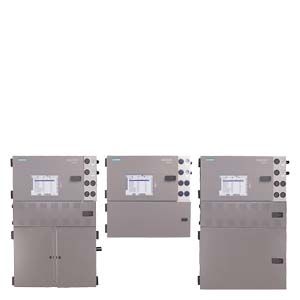
? Supply with carrier gas, combustion gas and auxiliary gases A gas chromatograph must be supplied with carrier gas and, if applicable, combustion gas and other auxiliary gases depending on the analytical configuration. The carrier gas is used to transport the sample through the analytical system. Auxiliary gases are used to operate valves, as combustion gases for flame ionization detectors, and to purge the oven. Injection system The injection system is the link between the continuous process stream and the discrete analytical process. It is responsible for injecting an exactly defined portion of the sample in a reproducible and pulsed manner (as far as possible) into the carrier gas stream. The injection can be carried out in the conventional manner using valves or by means of a live injection:
Gas injection valves Model 50 10-port valve:
Model 11 6-port valve:
Liquid injection valve FDV A constant quantity of a liquid sample can be automatically injected using the liquid injection valve, and subsequently vaporized rapidly and completely. The valve can also be used to inject small volumes of gas. The liquid injection valve consists of three sections:

Liquid injection valve FDV Features:
Live injection add-on part Flexible selection of the injection volume which is exactly matched to the analytical tasks and the requirements of the columns is possible with the live injection add-on part. 
Live injection Oven A further important factor for the separating performance is the temperature This has a very high influence on the vapor pressure of the individual components, and thus on the diffusion and the distribution equilibrium between the mobile and stationary phases in the column. This influences the retention times, and thus the identification of components. Therefore very high demands are placed on the temperature stability and repeatability of the oven and also on that of the injection equipment and the detectors. Two different types of oven are available: Airless oven for extremely stable isothermal oven temperatures (0.02 °C control accuracy) up to 80 °C (modular oven) or 280 °C depending on the version. Airbath oven for
Both types of oven are available as
With the dual ovens, two separate heating circuits provide independent oven temperatures. It is then possible to use two different temperatures for the respectively installed columns for one application or to carry out two or more applications in one chromatograph with different temperatures for the separation. In order to measure sample components with highly different volatilities, a temperature program is frequently used for the chromatographic separation. In this case the column temperature is continuously increased according to a selectable heating-up rate. This method (PTGC) is available with the MAXUM edition II. The internal oven consists of a chamber with low thermal capacity located within the standard oven. It contains the capillary column used for the separation. The ovens have separate, independent temperature control. The temperature of the internal oven is freely-programmable. The temperature changes according to the time-dependent profile assigned to the respective analysis. Up to three linear ramps and four constant periods can be configured. It is then possible to determine components with low and high boiling points in one analysis. Existing laboratory applications can be opened up by PTGC for use in the process industry. "Simulated distillation" is an important application of PTGC in refineries. The distillation range - a quality criterion for fuels - is chromatographically traced "online". Columns The columns are the central component of the chromatograph. They resolve the gas mixture or the vaporized liquid into its individual components. The following distinction is made:
Packed columns are mechanically stable and simple to handle. Capillary columns have a significantly higher separating performance, often with a shorter analysis period and lower analysis temperature. 
Types of column Column switching systems Process chromatographs are almost always equipped with column switching functions. Column switching is understood to be the combination of several columns in the carrier gas path which are arranged in succession or parallel. These columns usually have different separating performances, and are interconnected by valves for switching over the gas path. A distinction is made between backflushing, cut and distribution. A wide range of techniques is available for column switching. The techniques comprise highly stable membrane gas valves, membrane piston valves, sliding vane rotary valves and also valveless switching techniques. Valves Model 50 10-port valve:
Model 11 6-port valve:
Valveless switching technique The valveless live column switching is exactly controlled by electronic pressure regulators, and prevents falsification of results since the sample does not come into contact with valves. A special pressure-controlled coupling element connects the capillary columns. This technique is optimally suitable for capillary columns, and offers the best long-term stability and reliability. Live column switching is a technique where backflushing, cut or distribution is carried out on two different columns without any switching of valves or other moving components in the separation path. This is achieved using a unique coupling unit, the live T-piece. Its function is based on pressure difference control regulated by the electronic precision pressure controllers of the MAXUM edition II. Because there is no dead volume whatsoever, it is ideally suitable for the low flow rates used with capillary columns. Maintenance of the column switching configuration is then superfluous, the separating performance is improved, and complicated separating procedures are simplified. Live switching 
Live switching 
Column switching systems (examples) Solenoid valve control module
Electronic pressure controller module (EPC)
Detectors Thermal conductivity detectors (TCD) and flame ionization detectors (FID) are mainly used in process chromatography. Specific detectors such as flame photometer detector (FPD), electron capture detector (ECD), photo-ionization detector (PID), or helium ionization detector (HID) are used to a lesser extent. The detector modules described above can be combined together in many different manners in the MAXUM edition II.
Suitable detectors for process gas chromatography Thermal conductivity detectors (TCD) The measuring principle of the TCD is based on the difference between the thermal conductivity of a pure carrier gas stream and that of a gas mixture containing carrier gas and a component eluted from the column. Therefore all components whose thermal conductivity differs from that of the pure carrier gas can be detected by a TCD. TCDs always consist of one to three measuring cells and one or two reference cells which are electrically heated and contain wire resistors or thermistors connected in a Wheatstone bridge. The amount of heat transferred to the cells is the same as long as pure carrier gas flows through the measuring and reference cells. The resistances are therefore also very similar, and the bridge resistors are balanced. If a mixture of carrier gas and sample component flows through the sample chamber, the change in thermal conductivity of the gas mixture also changes the amount of heat transferred and thus the temperature and resistance of the heating wires or thermistors in the sample chamber. The resulting offset in the bridge circuit is directly proportional to the current concentration of the sample component in the carrier gas stream. Versions of TCDs:
Both detectors are available for universal use, and the filament detector can also be used at higher temperatures. The thermistor detector is available as a block with 6 measuring detectors and two reference detectors. The filament detector has a measuring cell and a reference cell. Flame ionization detector (FID) With the flame ionization detector (FID), the gas leaving the column is burnt in a constantly burning hydrogen flame. If this gas mixture contains thermally ionizable components, e.g. flammable organic compounds, ions are generated when the compounds are burnt. These ions can transport charges which change (increase) the conductivity of the gas in the vicinity of the flame. In order to measure the conductivity or the number of ions, these can be collected at an electrode. An electrode voltage is applied between the nozzle from which the flame burns and the electron collector positioned above it. The resulting current is amplified, and is the measured signal. In contrast to the TCD (concentration-dependent signal), the signal with the FID is proportional to the mass flow of the components. The FID features a linear range of 6 to 7 powers of ten, and permits detection limits of less than 0.1 ppm (referred e.g. to the concentration of the hydrocarbon in the sample). Non-flammable components or those which only thermally ionize with difficulty (e.g. inert gases and water), or components which do not indicate thermal ionization at approx. 1 700°C, cannot be measured with the FID. In addition to the carrier gas, hydrogen and air are required as the flame gases to operate this detector. Flame photometer detector (FPD) Further detector principles are used for determination of trace concentrations of specific components. For example, the flame photometer detector is used to determine traces of compounds containing sulfur or phosphor. The emission of light of characteristic wavelengths is measured when burning the substances in a reducing hydrogen flame. Pulsed discharge detector (PDD) The detector can be used in three different versions: HID (helium ionization detector), ECD (electron capture detector) and PID (photo ionization detector). Installation in the Maxum GC is possible without further modification, and the detector can only be used in non-hazardous areas. The PDD uses stable, pulsed DC discharges in helium as the ionization source. The detector's performance data is equal to or better than that of detectors which use radioactive ionization sources. Since a radioactive source is not used, the complex directives for radiation protection need not be observed by the customer.
Accessories: Catalytic air purifier Instrument air is usually contaminated by traces of hydrocarbons. If this air is used as the combustion gas for a flame ionization detector (FID), the impurities are evident as disturbing background noise. The catalytic air purifier eliminates interfering impurities of hydrocarbons in the combustion air for the FID detector. The products of the catalytic oxidation (H2O, CO2) have no influence on the detector. Use of the catalytic air purifier significantly reduces the background noise. It has a flameproof housing and is therefore explosion-proof. The air within the purifier is passed through a spiral lined with palladium. This metal spiral is heated up to approx. 600 °C. Palladium has a high activity at this temperature, and almost complete catalytic oxidation is achieved despite the short dwell time. The air subsequently passes through a cooling loop, and is output purified and cooled. Parallel chromatographyThis function divides a complex application into several simple sub-applications which are analyzed in parallel. This reduces the cycle times. The hardware and software of the MAXUM edition II allows a complex chromatographic analysis to be divided into several simple analyses. Each of these simple analyses can then be simultaneously executed in parallel. This not only simplifies the complete analysis, it can also be carried out faster and with greater reliability. In addition, maintenance of the simplified analyses is easier and faster. State-of-the-art communicationTCP/IP communication and standard Ethernet hardware mean that MAXUM edition II is compatible with many networks. Software For simple operation and maintenance, MAXUM edition II offers an online software system with local operation over an HMI and a flexible GUI accessible using a computer workstation. The online software system is installed in every MAXUM edition II or NAU and includes:
The PC Workstation Software Gas Chromatograph Portal comprises:
and optional packages for individual ordering, e.g.:
CompatibilityMAXUM edition II is compatible with all older types of chromatograph from Siemens: Advance Maxum. ApplicationCertain parameters must be observed during application and subsequent operation of the MAXUM edition II. It can then be determined qualitatively whether the task is fulfilled. The basic prerequisite for this is that all components can be detected and clearly isolated from the interfering components. Important parameters are: Analysis period, measuring ranges, detection limits and repeatability of the results. |
| Каталог 2018 | Каталог 2017 | Каталог 2016 | Каталог 2015 | Каталог 2014 | Каталог 2013 | Каталог 2012 | Сертификат | Контакты | Карта сайта | Поиск |


