


General technical specifications
Structure of the Article No. of the SIMOTICS S‑1FK2 servomotors
Regulations, standards, specificationsThe motors comply with the appropriate standards and regulations, see table below. As a result of the fact that in many countries the national regulations have been completely harmonized with the international IEC 60034‑1 recommendation, there are no longer any differences with respect to coolant temperatures, temperature classes and temperature rise limits.
 SIMOTICS S‑1FK2 motors have UL approval from Underwriters Laboratories Inc. and are marked with the "UL Recognized Component" test symbol. This is used for components which are part of a larger product or system. This confirmed compliance with the corresponding US American and Canadian regulations, and allowed access to the North American market.  For SIMOTICS S‑1FK2 motors, conformity with the relevant EC directives 2006/95/EC and 2014/35/EU and the relevant standards EN 60034‑1:2010 and EN 60204‑1:2006 is confirmed. By applying the CE mark to the product, Siemens AG confirms this for the product, and secures the free movement of goods within the European Union. Degree of protection acc. to IEC 60034‑5A suitable degree of protection must be selected according to the operating and environmental conditions to protect the machine against damage caused by the ingress of water and other liquids, as well as dust and foreign bodies. SIMOTICS S‑1FK2 motors have degree of protection IP64 as standard. The motor can be optionally supplied with a radial shaft seal ring in degree of protection IP65. This increases the protection against the ingress of liquids. The degree of protection designation is composed of the code IP (for International Protection) and two code numbers for the protection against touching and penetration of foreign bodies, and the degree of protection against the ingress of water. First code number 6: Protection against dust ingress and complete protection against touching Second code number 4: Protection against splashwater from all directions. 5: Protection against jet water from any direction Recommended degrees of protection for AC motors When cooling lubricants are used, protection against water alone is inadequate. The IP rating should only be considered as a guide value in this case. The motors may have to be protected by suitable covers. Attention must be paid to providing suitable sealing of the motor shaft for the selected degree of protection for the motor. The following table can serve as a decision aid for selecting the proper degree of protection for motors. A permanent covering of liquid on the flange must be avoided when the motor is mounted with the shaft extension facing upwards (IM V3).
Frame size, mounting position according to IEC 60034‑7SIMOTICS S‑1FK2 motors are designed in frame size IM B5. It can also be used in mounting positions IM V1 and IM V3.
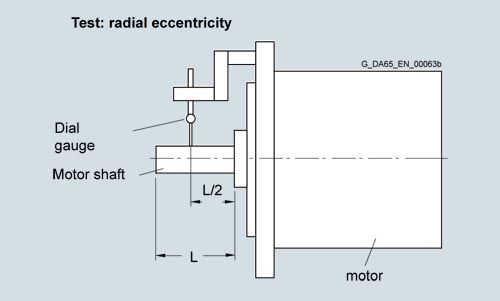
Shaft and flange accuracy in accordance with IEC 60072‑1Circular runout tolerance of shaft in relation to housing axis (in relation to the cylindrical shaft extension)
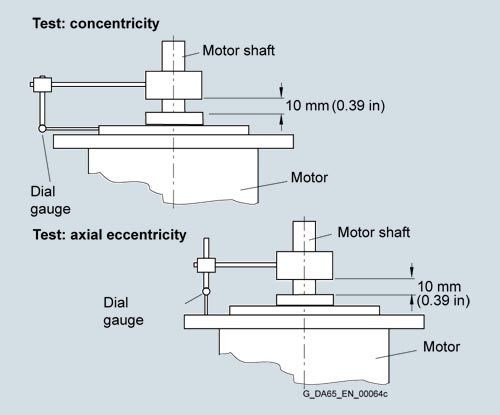
 Concentricity and axial eccentricity tolerance of the flange surface for the shaft axis (Referred to the centering diameter of the mounting flange)
 Vibration severity and vibration severity grade A according to IEC 60034‑14The vibration severity is the RMS value of the vibration velocity (frequency range from 10 Hz to 1 000 Hz). The vibration severity is measured using electrical measuring devices according to DIN 45666. The specified values refer only to the motor. These values can increase as a result of the overall system vibrational behavior due to installation.  Vibration severity limit values The speeds of 1 800 rpm and 3 600 rpm and the associated limit values are specified according to IEC 60034‑14. The motors maintain vibration severity grade A up to the rated speed. Balancing according to ISO 21940‑32Apart from the balance quality of the motor, the vibrational quality of motors with attached pulleys is mainly determined by the balance state of the mounted component. If the motor and the mounted component are balanced separately before being joined, the balancing process of the pulley is to be adapted to the motor's balancing type. SIMOTICS S‑1FK2 motors with feather keys are always half-key balanced. In general, motors with a plain shaft are recommended for systems with the most stringent vibrational quality requirements. Vibration stress, imitated vibration valuesThe requirements of environmental class 3M8 (according to EN 60721‑3‑3 Table 6) must be maintained for proper function and safeguard the bearing life. The following vibration values must not be exceeded.
During transport, the motors withstand single shocks (6 ms) of up to 250 m/s2 (820 ft/s2). Ambient temperature and installation altitudeOperating range without restrictions: Temperature range from -15 °C to +40 °C (5 °F to 104 °F), installation altitude up to 1 000 m (3 281 ft). For all other conditions, the permissible torque must be reduced with the aid of the factors given in the table below. The factors refer to the static torque M0. The S1 characteristic must be correspondingly shifted in parallel. Intermediate values must be interpolated correspondingly.
Encoder systemsIn motors with integrated OCC/DRIVE-CLiQ interface, the sensor signal is already digitally prepared in the motor, and then transferred quickly and without loss to the drive system. Motors with an OCC/DRIVE-CLiQ interface simplify commissioning and diagnostics, as the motor parameters and encoder system are identified automatically. Single-turn absolute encoder This encoder outputs an absolute angular position between 0° and 360° in the specified resolution. In contrast to the multi-turn absolute encoder, it does not have a revolution counter, and can therefore only supply the position value within one revolution. It does not have a traversing range. Multi-turn absolute encoder This encoder outputs an absolute angular position between 0° and 360° in the specified resolution. It can also count 4 096 revolutions. So with a ball screw, for example, the absolute position of the slide can be determined over a longer distance.
Holding brakeMany drives need a holding brake with an EMERGENCY STOP function for safety reasons or to meet process requirements. The brakes used on the SIMOTICS S‑1FK2 motors function according to the closed-circuit principle. A spring or permanent magnet exerts a tensile force on the brake armature disk, i.e. in a state of zero current, the brake is closed and the motor shaft thereby stopped. An electric current that flows through a coil generates an opposing field that counteracts the force effect of the spring or permanent magnet and releases or holds open the brake. Only a limited number of braking operations can be performed for an EMERGENCY STOP or power failure without causing excessive wear on the holding brake. The holding brake is not an operational brake. Regular dynamic braking leads to increased wear and premature brake failure. In order to ensure the functionality and specification of the brake, neither the total operating energy nor the maximum switching energy per braking operation may be exceeded. The braking signal is already fully integrated into the SINAMICS S210 converter system, so that an external circuit is not necessary. After an EMERGENCY STOP sequence with the maximum EMERGENCY STOP switching energy, a cooling time of at least 5 minutes must be allowed.
SIMOTICS S‑1FK2 shaft height 20 1FK2102-0AG..-..A0, 50 W  1FK2102-1AG..-..A0, 100 W Specific technical specifications
SIMOTICS S‑1FK2 shaft height 30 1FK2103-2AG..-..A0, 200 W  1FK2103-4AG..-..A0, 400 W Specific technical specifications
SIMOTICS S‑1FK2 shaft height 40 1FK2104-4AK..-..A0, 400 W  1FK2104-5AK..-..A0, 750 W Specific technical specifications
|
|||||||||||||||||||||||||||||||||||||||||||||||||||||||||||||||||||||||||||||||||||||||||||||||||||||||||||||||||||||||||||||||||||||||||||||||||||||||||||||||||||||||||||||||||||||||||||||||||||||||||||||||||||||||||||||||||||||||||||||||||||||||||||||||||||||||||||||||||||||||||||||||||||||||||||||||||||||||||||||||||||||||||||||||||||||||||||||||||||||||||||||||||||||||||||||||||||||||||||||||||||||||||||||||||||||||||||||||||||||||||||||||||||||||||||||||||||||||||||||||||||||||||||||||||||||||||||||||||||||||||||||||||||||||||||||||||||||||||||||||||||||||||||||||||||||||||||||||||||||||||||||||||||||||||||||||||||||||||||||||||||||||||||||||||||||||||||||||||||||||||||||||||||||||||||||||||||||||||||||||||||||||||||||||||||||||||||||||||||||||||||||||||||||||||||||||||||||||||||||||||||||||||||||||||||||||||||||||||||||||||||||||||||||||||||||||||||||||||||||||||||||||||||||||||||||||||||||||||||||||||||||||||||||||||||||||||||||||||||||||||||||||||||||||||||||||||||||||||||||||
| Каталог 2018 | Каталог 2017 | Каталог 2016 | Каталог 2015 | Каталог 2014 | Каталог 2013 | Каталог 2012 | Сертификат | Контакты | Карта сайта | Поиск |


