


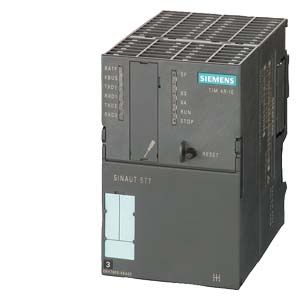
The TIM 4R-IE can be used as a standalone device, i.e. it is fully functional even without S7-300-CPU. In this stand-alone mode, the TIM is especially suitable as a SINAUT communications processor for the control desk PC (e.g. SINAUT ST7cc or ST7sc) or for a SIMATIC S7-400. The TIM is connected to the PC or S7-400 via one of its two Ethernet interfaces. If the control desk is redundantly designed or if an S7-400 is additionally available there as a higher-level controller, then the TIM performs the SINAUT communication with the stations for all these devices connected to the local Ethernet. The TIM 4R-IE can also be built into a SIMATIC S7-300 as a CP, e.g. if these devices require redundant transmission paths there or function as node stations at which more than two networks must be merged. All the devices mentioned can exchange data with other SINAUT ST7 or ST1 partners with the aid of the TIM 4R-IE and specifically via as many as four SINAUT networks that can also be operated in any redundant combination. The important SINAUT property - saving data complete with a time stamp on the TIM in the event of an interrupted link or failure of the partner - is then available not only for conventional WANs, but also for IP-based networks. Important events, alarms, etc. are not lost and the integrity of information in control center system archives is assured. Additional security is offered by the optional backup battery of the TIM 4R-IE which prevents the loss of saved data message frames if the 24 V supply fails. For setting up more complex control centers or node stations, several TIM 4R-IE modules can be used. Combinations with TIM 3V-IE Advanced and TIM 3 and other TIM 4 versions are also possible. As a communication module for the control desk PC, the TIM reduces the number of S7 connections that the PC would otherwise have to maintain when directly linked to the stations via an IP-based network, to just one (1) connection. In addition, the TIM then separates the local Ethernet from the IP-based network to the stations. Only SINAUT and PG communication with the stations is allowed through. This prevents unnecessary traffic in the WAN which is often not broadband. A TIM 4R-IE that is used at a redundant control desk reduces the data volume in a WAN and thus it reduces the costs for networks with volume tariffs, e.g. GPRS. If stations were connected directly to the redundant control desk (without central TIM 4R-IE), they would send each frame twice in order to send data to both control desk PCs. In the case of a control center TIM 4R-IE, the stations only send their message frames once. The doubling of the message frames for supplying both PCs is then performed by the control center TIM 4R-IE. For data transmission via conventional WANs, the TIM 4R-IE has other, special properties that predetermine its use as a "control center" TIM. SINAUT ST7 and thus also the TIM 4R-IE are designed for data transmission via the widest range of WANs or combinations of WANs. Mixed networks comprising classical SINAUT WAN networks (dedicated line, wireless, dial-up network) and IP-based networks (fiber optic, DSL, GPRS, Internet etc.) can be configured uniformly using SINAUT, which saves both time and money. For communication via the Internet, the integrated MSC-VPN tunnel protocol for direct access to DSL routers can be used. The TIM 4R-IE can operate here as an MSC server or MSC client. For communication via GPRS, either the router SCALANCE M874-2 can be connected to the Industrial Ethernet interface (VPN IPsec) or the GSM/GPRS modem MD720-3 (MSC-VPN) to the RS232 interface.
Controllable communication modules:
Special properties as "control center" TIM For data transmission via conventional WANs, the TIM 4R-IE has other, special properties that predetermine its use as a "control center" TIM:
Optional C-PLUG The most frequent application for the TIM 4R-IE will be its use as a communication module for the control desk PC or for an S7-400. The TIM then operates in standalone mode, i.e. without S7-300 CPU. The option of saving the TIM configuration data on the MMC card of the CPU, in order to exchange the TIM without a PG in the event of a fault, no longer applies. The saving of configuration data on the C-PLUG, which can be optionally equipped, solves this problem. This means that, even in standalone mode, a replacement of the TIM is possible without PG. |
| Каталог 2018 | Каталог 2017 | Каталог 2016 | Каталог 2015 | Каталог 2014 | Каталог 2013 | Каталог 2012 | Сертификат | Контакты | Карта сайта | Поиск |