


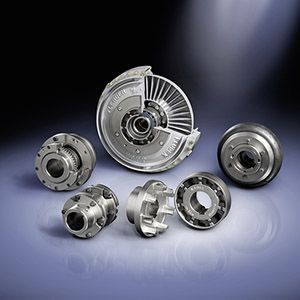
The torque load of the coupling must be determined from the output of the driven machine and the coupling speed. Rated coupling load TN = 9550 · PN / nN The rated coupling load obtained in this way must be multiplied by factors and compared with the rated coupling torque. An ideal but expensive method is to measure the torque characteristic on the coupling. For this, FLENDER offers special adapters fitted with torque measuring devices. The rated coupling torque TKN is the torque which can be transmitted by the coupling over an appropriate period of use if the load is applied to the coupling purely statically at room temperature. Application factors are to express the deviation of the real coupling load from the “ideal” load condition. Coupling load in continuous operationThe operating principles of the driving and driven machines are divided into categories and the application factor FB derived from these in accordance with DIN 3990-1.
Examples of torque characteristic of driving machines:
Examples of torque characteristic in driven machines:
1) The N-EUPEX coupling is not suitable for shock loads when used at low temperatures. NR = natural rubber, natural-synthetic rubber mixture Coupling size TKN ? TN · FB · FT In the case of ARPEX and ZAPEX coupling types, no temperature factor (FT = 1.0) need be taken into account. Coupling load under maximum and overload conditionsThe maximum torque is the highest load acting on the coupling in normal operation. TKmax ? Tmax · FT Overload torques are maximum loads which occur only in combination with special, infrequent operating conditions. TKOL ? TOL · FT Coupling load due to dynamic torque loadApplying the frequency factor, the dynamic torque load must be lower than the coupling fatigue torque. Dynamic torque load Frequency of the dynamic torque load Frequency of the dynamic torque load For the ZAPEX and ARPEX series, the frequency factor is always FF = 1.0. Checking the maximum speedFor all load situations nKmax ? nmax Checking permitted shaft misalignmentFor all load situations the actual shaft misalignment must be less than the permitted shaft misalignment. Checking bore diameter, mounting geometry and coupling designThe check must be made on the basis of the dimension tables. The maximum bore diameter applies to parallel keyways to DIN 6885. For other keyway geometries, the maximum bore diameter can be reduced. On request, couplings with adapted geometry can be provided. Coupling behavior under overload conditionsThe ZAPEX, ARPEX, N-EUPEX, RUPEX and BIPEX coupling series can withstand overloads until the breakage of metal parts. These coupling series are designated as fail-safe. The N-EUPEX DS, ELPEX-B, ELPEX-S and ELPEX coupling series throw overload. The elastomer element of these couplings is irreparably damaged without damage to metal parts when subjected to excessive overload. These coupling series are designated as non-fail-safe. These types that fail can be fitted with a so-called fail-safe device. This additional component enables emergency operation, even after the rubber element of the coupling has been irreparably damaged. Checking shaft-hub connectionThe torques specified in the tables of power ratings data of the coupling series do not necessarily apply to the shaft-hub connection. Depending on the shaft-hub connection, proof of form stability is required. FLENDER recommends obtaining proof of form strength by using calculation methods in accordance with the current state of the art.
Fitting recommendations for the shaft-hub connection are given in catalog section 15. The coupling hub is frequently fitted flush with the shaft end face. If the shaft projects, the risk of collision with other coupling parts must be checked. If the shaft is set back, in addition to the loadbearing capacity of the shaft-hub connection, the correct positioning of the hub must be ensured as well. If the bearing hub length is insufficient, restorative forces may cause tilting movements and so wear to and impairment of the axial retention. Also, the position of the set screw to be positioned on sufficient shaft or parallel key material must be noted. Checking low temperature and chemically aggressive environmentThe minimum permitted coupling temperature is specified in the Temperature factor FT table. In the case of chemically aggressive environments, please consult the manufacturer. |
||||||||||||||||||||||||||||||||||||||||||||||||||||||||||||||||||||||||||||||||||||||||||||||||||||||||||||||||||||||||||||||||||||||||||||||||||||||||||||||||||||||||||||||||||||||||||||||||||||||||||||||||||||||||||
| Каталог 2018 | Каталог 2017 | Каталог 2016 | Каталог 2015 | Каталог 2014 | Каталог 2013 | Каталог 2012 | Сертификат | Контакты | Карта сайта | Поиск |