


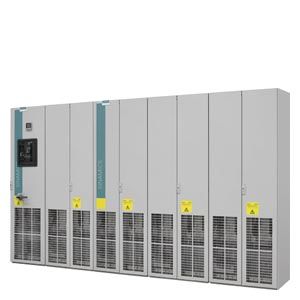
? Communication with higher-level control and customer terminal blockAs customer interface to the control system, as standard there is a PROFIBUS interface at the CU320-2 DP Control Unit or a PROFINET interface at the CU320-2 PN Control Unit. The inputs and outputs available as standard at the customer terminal block -X55 are easy to access and easy to connect. For additional information, please refer to the SINAMICS Low Voltage Engineering Manual. Open-loop and closed-loop control functionsSINAMICS S120 has a high-dynamic vector control with speed and current control – with and without speed actual value feedback. Software and protective functionsThe software functions available as standard are described below:
Power unit protection
Safety Integrated functionsThe integrated safety functions of SINAMICS provide highlyeffective application-oriented protection for personnel and machinery. The Safety Integrated functions are implemented electronically and therefore offer short response times in comparison to solutions with externally implemented monitoring functions. The trend toward greater complexity and increasing modularity of machines is increasingly seeing a shift in safety functions away from the classical central safety functions (for example, shutdown of the complete machine using a main switch) and into the machine control system and the drives. Frequently, this also significantly increases the productivity. This is because, for instance, equipping times can be reduced and during these equipping times, depending on the machine type, other parts can still continue to produce. Integrated safety functions act much faster than those of a conventional design. The safety of a machine is increased further with Safety Integrated. Furthermore, thanks to the faster method of operation, safety measures controlled by integrated safety systems are perceived as less of a hindrance by the machine operator, therefore significantly reducing the motivation to consciously bypass safety functions. The safety functions in the device and communication via PROFIsafe have already been certified. This simplifies configuring the safety functions and especially the acceptance of the plant or system by an authorized testing body when compared to safety solutions made up of individual safety components. Legal framework Machine and plant builders must ensure that their machines or plants neither present risks due to electric shock, heat or radiation nor due to functional faults. In Europe, for example, compliance with the machinery directive is legally stipulated by the EU industrial safety directive. In order to ensure compliance with this directive, it is recommended that the corresponding harmonized European standards are applied. This initiates the assumption of conformity and gives manufacturers and operators the legal security when complying with both national regulations and EU directives. The machine manufacturer uses the CE marking to document the compliance with all relevant directives and regulations in the free movement of goods. Safety-related standards Functional safety is specified in various standards. EN ISO 12100 and EN ISO 14121-1, for example, are concerned with the design and risk assessment of machines. EN 62061 (only applicable for electrical and electronic control systems) and EN ISO 13849-1 (previously EN 954-1) define the functional and safety-related requirements of control systems with relevance to safety. The above-mentioned standards define different safety requirements that the machine has to satisfy in accordance with the risk, frequency of a dangerous situation, probability of occurrence and the opportunities for recognizing impending danger.
Safety functions integrated in the drive with SINAMICS The safety functions integrated in SINAMICS satisfy the requirements of
In addition, the Safety Integrated functions of SINAMICS are generally certified by independent institutes. An up-to-date list of certified components is available on request from your local Siemens office. Safety Basic Functions and Safety Extended Functions The Safety Integrated functions of the SINAMICS drive system are subdivided into what are known as Safety Basic Functions and Safety Extended Functions (terminology according to IEC 61800?5?2):
The Safety Integrated functions currently available in SINAMICS S120 are subsequently described in more detail (terms as defined in IEC 61800?5?2): Safe Torque Off (STO)Function description This function prevents unexpected starting according to EN 60204-1 Section 5.4. Safe Torque Off disables the control of the power unit, preventing a potentially hazardous torque (corresponds to Stop Category 0 according to EN 60204-1). The drive is reliably torque-free. This state is monitored internally in the drive. Under Extended Functions, STO can also be controlled via the TM54F Terminal Module or PROFIsafe. Application, customer benefits STO has the immediate effect that the drive cannot supply any torque-generating energy. STO can be used wherever the drive will naturally reach a standstill due to load torque or friction in a sufficiently short time or when "coasting down" of the drive will not have any relevance for safety. 
Safe Brake Control (SBC)Function description The Safe Brake Control SBC is used to control holding brakes, which are active in the no-current state, e.g. motor holding brakes (actuated using spring force). The brake is controlled through two channels in a safety-relevant fashion. Safe Brake Control is executed when activating the operational brake control, Safe Torque Off function and when safety monitoring functions respond, which cause the power unit to be safely inhibited.
Application, customer benefits In conjunction with STO and SS1, SBC can also be activated. After switching off the torque-generating energy, SBC offers the possibility to safely control a holding brake at the motor; for example, to prevent hanging/suspended axes from sagging. 
Safe Stop 1 (SS1, time-controlled, without encoder; Basic Safety Function)Function description The Safe Stop 1 function can safely stop the drive in accordance with EN 60204-1, Stop Category 1. When the SS1 function is selected, the drive independently brakes along a quick stop ramp (OFF3) and Safe Torque Off and Safe Brake Control (if enabled) are activated when the selected safety delay time has expired. Application, customer benefits When activating the stop function, if the drive does not come quickly enough to a standstill as a result of the load torque, then it can be actively braked by the converter. As a result of this integrated fast brake function, frequently it is possible to eliminate mechanical brakes which wear, or to reduce the load on them. This means that maintenance costs and stress on the machine can be reduced. 
Safe Stop 1 (SS1, time and acceleration controlled, with sine-cosine encoder; Extended Safety Function)Function description The Safe Stop 1 function can safely stop the drive in accordance with EN 60204-1, Stop Category 1. When the SS1 function is selected, the drive independently brakes along a quick stop ramp, the deceleration is monitored (OFF3) and Safe Torque Off and Safe Brake Control (if enabled) are automatically activated when the selected safety delay time has expired. Application, customer benefits When activating the stop function, if the drive does not come quickly enough to a standstill as a result of the load torque, then it can be actively braked by the converter. As a result of this integrated fast brake function, frequently it is possible to eliminate mechanical brakes which wear, or to reduce the load on them. This means that maintenance costs and stress on the machine can be reduced.
Safe Stop 2 (SS2, with sine-cosine encoder)Function description The Safe Stop 2 function can safely stop the drive in accordance with EN 60204-1, Stop Category 2. When the SS2 function is selected, the drive brakes autonomously along a quick stop ramp (OFF3). In contrast to SS1, the drive control remains operational afterwards, i.e. the motor can supply the full torque required to maintain the actual position. Standstill is safely monitored (Safe Operating Stop function, SOS). Application, customer benefits Just the same as for SS1, the drive is independently braked when the stop function is selected. Contrary to SS1, also at standstill, the drive can provide the full torque.
Safe Stop 1 (SS1) and Safe Stop 2 (SS2) with Safe Acceleration Monitor (SAM, with sine-cosine encoder)For the Extended Functions Safe Stop 1 (SS1) and Safe Stop 2 (SS2) with SAM, during braking, the acceleration is safely monitored (S Safe Operating Stop (SOS, with sine-cosine encoder)Function description The Safe Operating Stop function constitutes safe standstill monitoring. The drive control remains in operation. The motor can therefore deliver the full torque to hold the current position. The actual position is reliably monitored. In contrast to safety functions SS1 and SS2, the speed setpoint is not influenced autonomously. After SOS has been selected, the higher-level control must bring the drive to a standstill within a parameterized safe time ?t and then hold the position setpoint. After the time ?t has expired, SOS is activated and monitored to ensure that the actual standstill position is not left. Application, customer benefits SOS is the ideal function for all those applications for which the machine or parts of the machine must be at a safe standstill for certain machining steps, but where the drive must also supply a holding torque. 
Safely-Limited Speed (SLS, with sine-cosine encoder)Function description Using the Safely-Limited Speed function, the drive is monitored against a parameterizable maximum velocity. Four different limit values can be activated. Just the same as for SOS, the speed setpoint is not independently influenced. After SLS has been selected, the higher-level control must bring the drive to below the selected velocity limit within a parameterizable time ?t. Application, customer benefits When setting-up many machines operating personnel must work on the machine as it rotates. This must either be done in steps, because the dangerous area must always be exited at each start, or alternatively, the operator works at the machine while it moves and is therefore exposed to an increased risk. When using the SLS function, a considerable amount of time can be saved – and it is still guaranteed that the operating personnel are safe. For this purpose, the drive velocity can be safely limited to a safe low level. The selectable wait time until SLS is activated allows the drive control to run-down the coordinated axes in a controlled fashion. 
Safe Speed Monitor (SSM, with sine-cosine encoder)Function description The Safe Speed Monitor function supplies a safety feedback signal (high active) if the drive falls below a selectable velocity limit value. Contrary to the functions described above, there is no drive-based fault response when the limit value is exceeded. Application, customer benefits The safety SSM feedback signal can be used in a higher-level control for safety-relevant responses. The higher-level safety control can flexibly respond to the signal, depending on the particular situation, as there is no drive-based response when the limit value is exceeded. For example, using the SSM signal, a protective door can be released after a non-hazardous velocity is reached. 
Safe Direction (SDI, with sine-cosine encoder)Function description The SDI function ensures that the drive can only rotate in the selected direction. Deviation from the direction of rotation currently being monitored is detected reliably and the configured drive-integrated fault reaction is initiated. It is possible to select which direction of rotation is to be monitored. Application, customer benefits The SDI function is used when the drive may only move in one direction. A typical application is to permit the operator access to a danger zone, as long as the machine is rotating in the safe direction, i.e. away from the operator. In this state, the operator can feed material into the work zone/remove material from the work zone without danger. The function saves the use of external components e.g. speed monitors and the associated wiring. The release of a danger zone, while the machine is moving away from the operator, increases productivity. Without the SDI function, the machine must be safely stopped during material loading and removal. 
PROFIsafePROFIsafe is an open communication standard, that facilitates standard and safety-relevant communication along one communication path (hard-wired or wireless). As a consequence, a second, separate bus system is not required. The telegrams that are sent are continually monitored to ensure safety-relevant communication. Possible errors such as telegrams that have been lost, repeated or received in the incorrect sequence etc. are avoided. This is done by consecutively numbering the telegrams in a safety-relevant fashion, monitoring their reception within a defined time and transferring an ID for transmitter and receiver of a telegram. Further, a cyclic redundancy check CRC (cyclic redundancy check) is performed. SINAMICS 120 supports the PROFIsafe profile, based on PROFIBUS as well as on PROFINET. LicensingThe Safety Integrated Basic Functions do not require a license. A license is, however, required for each axis with safety functions in the case of Safety Integrated Extended Functions. It is irrelevant which safety functions are used and how many. Licenses required for SINAMICS S120 Cabinet Modules can be ordered, depending on the axes, with safety options K01 to K05 for Motor Modules. An overview of the SINAMICS Safety Integrated functions plus their boundary conditions is provided in the following table:
1) In addition for SINAMICS S120 Cabinet Modules and SINAMICS S150 Converter Cabinet Units. 2) Safe Brake Adapter has been released from firmware version 4.4. 3) For SINAMICS 120 Cabinet Modules and SINAMICS S150 Converter Cabinet Units as option K87. 4) The Safety Integrated Extended Functions require a sine-cosine encoder to sense the motor speed. Possible encoder evaluation units SMC20, SMI20, SME20/25/120/125. The principle of operation of Safety IntegratedTwo independent shutdown paths There are two shutdown paths that are independent of one another. All shutdown paths are low active. This therefore ensures that when a component fails or there is a wire break, then the system always goes into the safe state. When a fault is detected in the shutdown paths, the Safe Torque Off or Safe Stop 1 function (depending on the parameterization, also refer to the table above) is activated and a restart is prevented. Two-channel monitoring structure All of the hardware and software functions important for Safety Integrated are implemented in two independent monitoring channels (e.g. shutdown paths, data management, data comparison). The safety-relevant data in the two monitoring channels is cyclically compared crosswise. The monitoring functions in each monitoring channel are based on the principle that before a particular action, there must be a defined state, and after the action there must be a specific feedback. If this expectation is not fulfilled in a monitoring channel, then the drive is shutdown through two channels and the appropriate signal output. Forced checking procedure using a test stop In order to fulfill the requirements of EN ISO 13849-1 (previously EN 954-1) and IEC 61508 regarding early fault detection, the functions and the shutdown paths must be tested within a specific time period at least once to ensure that they are operating correctly. This must be realized either cyclically and manually or the test stop must be automatically initiated as part of the process. The test stop cycle is monitored, and after a specific time has been exceeded, an alarm is output. A test top does not require a power on. The acknowledgment is realized when deselecting the test stop request. When the machine is operational, it can be assumed that there is no risk for personnel as a result of the appropriate safety equipment (e.g. protective doors). As a consequence, the user is only made aware of the forced checking procedure that is required using an alarm, and is requested to perform the forced checking procedure at the next possible opportunity. Examples for performing the forced checking procedure:
|
|||||||||||||||||||||||||||||||||||||||||||||||||||||||||||||||||||||||||||||||||||||||||||||||||||||||||||||||||||||||||
| Каталог 2018 | Каталог 2017 | Каталог 2016 | Каталог 2015 | Каталог 2014 | Каталог 2013 | Каталог 2012 | Сертификат | Контакты | Карта сайта | Поиск |