


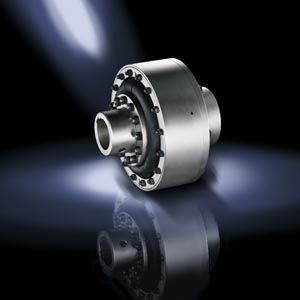
The ELPEX coupling is especially suitable for rough operation. An application factor different from that in catalog section 3 is therefore sufficient for all applications. In the case of machines which excite torsional vibration, FLENDER urgently recommends carrying out a torsional vibration calculation or measuring the coupling load occurring in the drive. Coupling selectionCoupling load in continuous operation The operating principles of the driving and driven machines are divided into categories and the application factor FB derived from these in accordance with DIN 3990-1.
Examples of torque characteristic in driven machines:
NR: Natural rubber mixture Select size with: TKN ? TN · FB · FT Coupling load at maximum and overload conditionsThe maximum torque is the highest load acting on the coupling in normal operation. TKmax ? Tmax · FT Overload torques are maximum loads which occur only in combination with special, infrequent operating conditions. Examples of overload torque conditions are: Motor short circuit, emergency stop or blocking because of component breakage. Overload torques at a frequency of once a month are permitted and must be lower than the maximum overload torque of the coupling. The overload condition may last only a short while, i.e. fractions of a second. TKOL ? TOL · FT Coupling load due to dynamic torque load Applying the frequency factor FF, the dynamic torque load must be lower than the coupling fatigue torque. Dynamic torque load Frequency of the dynamic torque load Frequency of the dynamic torque load Checking the maximum speed: The following must apply to all load situations: nKmax ? nmax Checking permitted shaft misalignment and restorative forces For all load situations the actual shaft misalignment must be less than the permitted shaft misalignment. Checking bore diameter, mounting geometry and coupling design The check must be made on the basis of the dimension tables. On request, couplings with adapted geometry can be provided. Checking shaft-hub connection Please refer to catalog section 3 for instructions. Checking temperature and chemically aggressive environment The permitted coupling temperature is specified in the Temperature Factor FT table. In the case of chemically aggressive environments, please consult the manufacturer. |
||||||||||||||||||||||||||||||||||||||
| Каталог 2018 | Каталог 2017 | Каталог 2016 | Каталог 2015 | Каталог 2014 | Каталог 2013 | Каталог 2012 | Сертификат | Контакты | Карта сайта | Поиск |