

The MAXUM edition II and MicroSAM gas chromatographs can transfer measured results and status information to process control systems, operator panels or printers during operation. InterfacesChromatograph, operator panel, printer and control system use special electronic interfaces:
MODBUSMODBUS is a rule for controlling data transfer between two computer systems - a transmission protocol. MODBUS is the "de facto" industry standard for connecting measuring and control devices to process control systems (PCS). Most process control systems can be equipped with serial interfaces and MODBUS. Using the MODBUS coupling, information can be sent interference-proof via just one data line. Information can be read from process gas chromatographs (PGC), and certain functions of the PGC can also be parameterized. Advantages:
The MODBUS coupling can:
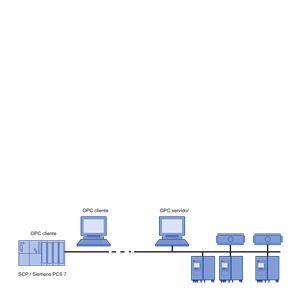
The MODBUS uses a master/slave transmission procedure. The control system is always the master, the process gas chromatograph is the slave. The representation of data in the message frames is based on the compact RTU format. Memory division To ensure that the meaning of the registers is known to each network station, this must be defined in the configuration. The results of each component in each sample must be written into defined positions in the PCS memory. These address declarations depend on the number of chromatographs, samples and components. The same applies to status, sample sequence and sample release. Standard addresses are also defined in these cases. OPC server (OLE for Process Control)OPC is a vendor-independent software interface. It allows standardized access from Windows applications to chromatograph data. OPC corresponds to a typical client/server architecture. OPC allows a universal connection between any Windows application which supports an OPC client interface and the MAXUM edition II / MicroSam. The OPC server is usually installed on a separate PC. OPC is a modern alternative to MODBUS. MAXUM edition II and MicroSAM do not require an additional interface, they use the existing Ethernet connection (TCP/IP). OPC standardizes the access to measured values, status functions, control functions and analytical data in a manner similar to MODBUS. Advantages with OPC applications:
 OPC server Hardware componentsNAU - Network Access Unit An NAU expands and supplements a GC network, and has three fundamental functions:
The Network Access Unit (NAU) is an input/output station for the Siemens process chromatographs. It can be used to centrally call, process and pass on data. It is used if it is not possible to connect the electronics close to the analyzer, if the number of MicroSam inputs/outputs is insufficient, or if installation in a central control room is required. This significantly reduces the required wiring to the control room. The NAU can also be used as a central control unit for function testing, data output and parameterization of the MicroSam. It permits access to the MicroSam to which it is connected, as well as to all other Siemens gas chromatographs and further NAUs of the system which are networked over the system bus. The NAU is connected to the Ethernet or DataNet and has a total of 7 slots to accommodate a wide range of electronics cards. These comprise cards for analog and digital signal processing as well as interfaces for host computers and process control systems. An NAU can be expanded by a further 10 slots using a CAN Extension Unit. A total of 7 different electronics cards are available:
CEU - CAN Extension Unit (only MAXUM edition II)
ANG - Advance Network Gateway Connects OptiCHROMs to the Ethernet network. DNH - DataNET Hub Communications router completely redundant in the network: has 2 own TCP/IP addresses, dual electronics and power supply. ANCB - Advance Network Communication Board Converts the communications protocols in the device Two versions:
Software Modern chromatographs are controlled by microprocessors. Software in the chromatograph The chromatograph can carry out analyses independently, without an operator panel being connected. It then requires its own control software and local operating software (HMI). Software in the operator panel (PC) Siemens gas chromatographs can be operated over Ethernet and a PC, by using the built-in control panel (HMI), or with a Network Extension Unit (NAU). Workstation software The most important programs this contains are the MAXUM System Manager, the MAXUM EZChrom and the HMI-Emulation. In addition, it contains useful MAXUM utilities and loadable extensions such as: MaxBasic For modification of MaxBasic programs in the gas chromatographs or the NAU. MAXUM OPC Server For coupling of the MAXUM e.g. to control systems. Simulated Distillation For import/export of methods for simulated distillation. MAXUM System Tools For data logging, for firmware updating, or for operation of discontinued OptiCHROMs (APC 8.0). Different levels of operation Operation of the PC is in three levels:
System Manager: The System Manager provides the connection to the chromatograph as well as an overview of the network. It is additionally used for configuration and high-level monitoring of the chromatograph, and additionally branches to the MMI emulation, EZ Chrom and Basic editor. The System Manager almost exclusively outputs static displays, i.e. it fetches a table from the chromatograph's database, and saves it again there later. Only results and alarms are displayed dynamically. The System Manager presents the hardware in tables, e.g. the system table contains all hardware components of the chromatograph: detectors, valves, ovens, digital outputs, etc. In addition, the System Manager can:
EZChrom: The EZChrom software is installed on the PC and is also included in the operator software in the chromatograph, e.g. it integrates the detector signals there, calculates the results, or switches time-controlled events. EZChrom on the PC is responsible for the following tasks:
MMI emulation: Operator control and monitoring This is identical to operation on the built-in control panel of a MAXUM or an NAU. It is used for operator control and monitoring. For example, it is possible to display results, switch valves or modify temperatures. However, there are only minimum possibilities for editing the configuration and tables. The MMI is always a dynamic display. APC 8.0 This is an interface to the OptiCHROM Advance gas chromatographs. It is started from the MAXUM System Manager. It permits operation of older types of chromatograph via a PCI card. The following can be executed with APC 8.0:
GC-Tools operating software GC-Tools is the Windows-based operating software for discontinued Siemens gas chromatographs of Series 202 and 302. This software expands the BEDI operating software, which is based on MS-DOS. The Network Explorer shows all information at the device level, e.g.:
|
| Каталог 2018 | Каталог 2017 | Каталог 2016 | Каталог 2015 | Каталог 2014 | Каталог 2013 | Каталог 2012 | Сертификат | Контакты | Карта сайта | Поиск |