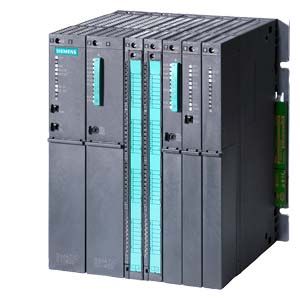
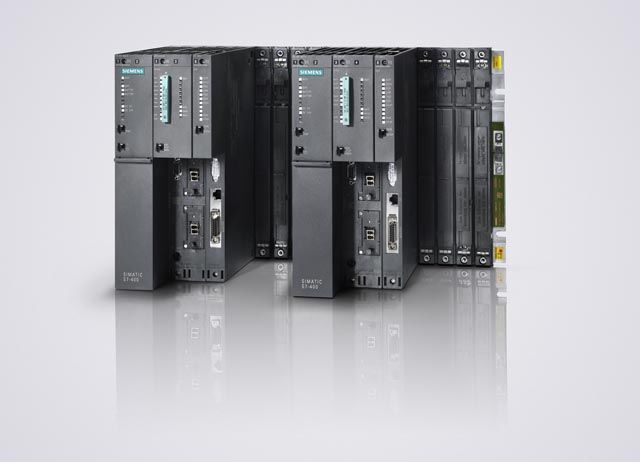
The S7-400 is the most powerful PLC in the family of SIMATIC controllers. It enables successful automation solutions with Totally Integrated Automation (TIA). The S7-400 is an automation platform for system solutions in production and process engineering, and it is characterized primarily by its modularity and performance reserves.
S7-400
The power PLC for the mid to high-end performance ranges
The solution for even the most demanding tasks
With a comprehensive range of modules and performance-graded CPUs for optimal adaptation to the automation task
Flexible in use through simple implementation of distributed structures
User-friendly connections
Optimal communication and networking options
User-friendly handling and uncomplicated design without a fan
Can be expanded without problems when the tasks increase
Multicomputing: Simultaneous operation of several CPUs in one S7-400 central controller. Multicomputing distributes the overall performance of an S7-400. For example, complex tasks in technologies such as open-loop control, computing or communication can be split and assigned to different CPUs. And every CPU can be assigned its own local I/O.
Modularity: The powerful backplane bus of the S7-400 and the communication interfaces that can be connected direct to the CPU enable high-performance operation of a host of communication lines. This permits, for example, the division into one communications line for HMI and programming tasks, one line for high-performance and equidistant motion control components, and one "normal" I/O fieldbus. Additionally required connections to MES/ERP systems or the Internet can also be implemented.
Engineering and diagnostics: The S7-400 is configured and programmed extremely efficiently together with the SIMATIC Engineering Tools particularly in the case of extensive automation solutions with a high engineering component. For this purpose, high-level languages such as SCL and graphical engineering tools for sequential controls, state graphs and technology-oriented diagrams are available, for example.
S7-400H
High-availability automation system with redundant design
For applications with high fail-safety requirements: Processes with high restart costs, expensive downtimes, little supervision, and few maintenance options
Redundantly designed central functions
Increases availability of I/O: switched I/O configuration
Also possible to use I/Os with standard availability: single-sided configuration
Hot stand-by: Automatic reaction-free switching to the standby unit in the event of a fault
Configuration with 2 separate or one divided central rack
Connection of switched I/O via redundant PROFIBUS DP or system-redundant PROFINET I/O.
S7-400F/FH
Failsafe automation system for plants with increased safety requirements
Complies with safety requirements to SIL 3 in accordance with IEC 61508, AK6 in accordance with DIN V 19250 and Cat. 4 in accordance with EN 954-1
If required, also fault tolerant through redundant design
Without additional wiring of the safety-related I/O
Safety-relevant communication via PROFIBUS DP with PROFIsafe profile
Based on S7-400H and distributed ET 200 I/O with fail-safe modules
Standard modules for non-safety-related applications can also be used in the automation system
Isolation module for the combined use of fail-safe and standard modules in safety mode in one ET 200M.
Catalog ST 70
You can also find information about SIMATIC S7-400 in the Catalog ST 70: