|
| | | | | | | | |
?
- Compact design (e.g. for turning machines and vertical milling machines) by dispensing with mechanical components, such as motor switch armature, belt drive, gearbox and spindle encoder
- High power density thanks to water cooling
- Maximum speed up to 40000 rpm, torque up to 820 Nm for S1 duty
- Higher torque - up to 60 % - with the same active component volume, consequently more compact machine design compared to SIMOTICS M-1PH2
- Extremely short ramp-up and braking times (50 %) thanks to higher torque compared to SIMOTICS M-1PH2
- Cold rotor due to excitation using permanent magnets, this means significantly less power loss in the rotor in the lower speed range and therefore less bearing heating and spindle expansion
- The stator and rotor are ready to install, no finishing is necessary.
- The absence of drive transverse forces permits extremely high accuracy on the work piece thanks to smooth, accurate spindle motion even at very low speeds.
- Larger rotor inner bore than squirrel-cage rotor of asynchronous motors, but with the same outer diameter, which is an advantage with regard to the bar capacity of automatic turning machines and results in higher spindle stiffness due to larger shaft diameters for milling spindles.
- Increased rigidity of the spindle drive achieved by mounting the motor components between the spindle main bearings
- Less cooling capacity required for the same power compared to SIMOTICS M-1PH2, i.e. greater efficiency
- Only one encoder (hollow-shaft measuring system) for sensing motor speed and spindle position
- Simple servicing by replacing complete motor spindles
- Compatible system of SINUMERIK, SINAMICS or SIMODRIVE and motor, therefore fast commissioning is ensured
- Higher machine productivity:
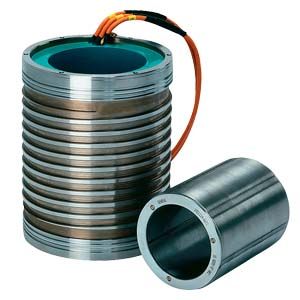
The permanent-magnet-excited motor spindles (PE spindles) increase the power density and economic efficiency of CNC machines. The optimized combination of SIMOTICS M-1FE1 built-in motor, drive control and CNC offers further opportunities for rationalization, such as lower workpiece machining times and fewer clamping faces.
|
|