


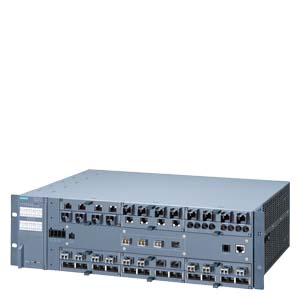
- Integrated redundancy manager for constructing ring topologies with up to 10 Gbit/s and high-speed media redundancy. By interconnecting the ends of an optical or electrical line to form a ring, reliable communication can be achieved. The redundancy manager (RM) integrated in the SCALANCE XR-500 switch monitors the function of the network. It recognizes the failure of a transmission link or of SCALANCE X switch in the ring and activates the substitute path within a maximum of 0.2 seconds.
- Redundant Layer 2 interfacing to company networks;
SCALANCE XR-500 switches support the standardized redundancy procedures Multiple Spanning Tree Protocol (MSTP), Rapid Spanning Tree Protocol (RSTP), and Spanning Tree Protocol (STP). This enables a subnetwork to be connected redundantly to a higher-level corporate network with reduced requirements for the reconfiguration time (in the order of seconds). - The Layer 3 switching functions1) (optional) enable simple subdivision of large networks into smaller subnetworks with their own address space. Reasons for subdivision into subnetworks include separation of the Ethernet network to reduce the volume of traffic, separation of sensitive areas from the main network, and subdivision of the network into logical working groups.
- Redundant Layer 3 connection to corporate networks;1);
SCALANCE XR-500 switches support the standardized routing protocols Open Shortest Path First (OSPF) and Routing Information Protocol (RIP), and the standardized routing procedure Virtual Router Redundancy Protocol (VRRP). This means industrial, routed subnetworks can also be connected redundantly to a higher-level corporate network. - Thanks to support for the Dual Stack Routing function, both IPv4 addressing and IPv6 addressing can be operated in one network.
- Support of virtual networks (VLAN);
for structuring Industrial Ethernet networks with a fast growing number of users, a physically existing network can be divided into several virtual networks. Port-based, protocol-based and IP-based VLANs are available for selection. - Load limiting when multicast protocols (e.g. video transmission) are used;
through learning the multicast sources and targets (IGMP Snooping, IGMP Querier), SCALANCE XR-500 switches can also filter multicast data traffic and therefore limit the load in the network. Multicast and broadcast traffic can be limited. - Time synchronization;
diagnostic messages (log table entries, e-mails) are time-stamped. The local time is standardized throughout the network by means of synchronization with a SICLOCK time transmitter or SNTP/NTP server, thereby simplifying the assignment of diagnostic messages to several devices. - Link aggregation (IEEE 802.1q) for bundling data streams
- Quality of Service (IEEE 802.1p) for prioritization of network traffic

Increasing the transmission bandwidth by means of link aggregation
Network topology and network configuration
The network topology can easily be adapted to the structure of the plant using SCALANCE XR-500 Industrial Ethernet switches .
The following network structures and combinations of structures can be implemented:
- Ethernet with fast media redundancy;
to increase network availability, as many as 50 X-200, X-300, X-400 or X-500 switches cascaded in line can be connected into a ring. - Several rings can be redundantly linked through the standby function
- Star topology with SCALANCE XR-500 switches:
Each SCALANCE XR-500 switch represents a neutral point that can connect up to 52 nodes or subnets with each other electrically.

Use of SCALANCE XR-500 in redundant network topologies, e.g. with Rapid Spanning Tree Protocol (RSTP) and ring redundancy
When configuring the network, it is necessary to observe the following boundary conditions:
- Maximum line length between two modules for multi-mode fiber-optic conductors:
- 5 km at 100 Mbit/s
- 750 m at 1000 Mbit/s
- 300 m at 10 Gbit/s
- Maximum line length between two modules for single-mode fiber-optic conductors:
- 26 to 70 km at 100 Mbit/s
- 10 to 120 km at 1000 Mbit/s
- 10 to 40 km at 10 Gbit/s
- Maximum cable length of the TP cable between two SCALANCE X switches:
- Max. 100 m with IE FC Cable 2 x 2 and IE FC RJ45 Plug 180
- Max. 100 m at 1 Gbit/s with IE FC Standard Cable 4 x 2 (90 m), IE FC RJ45 Modular Outlet and patch cable (10 m)
- Max. 10 m using patches with TP Cord
Commissioning and diagnosis
Setting options on the device itself:
- Redundancy manager RM;
to establish a ring, a SCALANCE XR-500 is switched to RM mode. The non-ring ports of the RM can be used freely for the connection of data terminals and networks. If the redundancy procedure MRP standardized by PROFINET is used, the RM is adjusted automatically. - Signal mask;
the signal mask is set to the current status of the SCALANCE XR-500 (setpoint) by pushbutton operation. The signal mask defines which ports and which power supplies are to be monitored. The signaling contact only reports an error when a monitored port or a monitored feeder fails (deviation of setpoint/actual status). - IP address;
the IP address is assigned via DHCP (DynamicHostConfigurationProtocol). If there is no corresponding server in the network, the IP address can be assigned using an enclosed software tool.
Diagnostic options on site:
- The following status information is displayed by LEDs on site:
- Port status
- Port mode (Mbit/s, full/half-duplex)
- Status of the two power supplies
- Signaling contact status
- Signal mask (setpoint status)
- RM mode
- Standby mode
- The status of the signaling contact is routed externally by means of floating relay contacts. This enables, for example, the module to be monitored via an input module from a controller.
- Monitoring via the Industrial Ethernet network;
the following possibilities are available:- Via standard browser (Web-based management):
Selection of SCALANCE XR-500 switches via the network from a PC with browser - Via SNMP V1, V2c, V3:
Secure integration of SCALANCE XR-500 switches via the network into a network management system, e.g. SINEMA Server - Via PROFINET IO diagnostics:
PROFINET diagnostic alarms from SCALANCE XR-500 switches can be displayed using the relevant SIMATIC engineering tools and they can also be processed in the controller. The engineering outlay for the PLC and HMI have been drastically reduced due to the complete integration in the SIMATIC concept for system error messages.
- Via standard browser (Web-based management):
Network management
The network management provides the following functions:
- Password-protected dial-up for "Administrator" (read and write authorization) and "User" (read only)
- Read-out of version and status information
- Setting the signal and standby mask and address information
- Fixed parameterization of the ports (data rates, half/full duplex)
- Setting of Spanning/Rapid/Multiple Spanning Tree parameters
- Parameterization of the web management services
- Security
- Ports can be connected or disconnected
- Port-based network access control according to IEEE 802.1x
- Authentication in accordance with IEEE 802.1x
- Support of Access Control List (ACL)
- Output of statistics information
- Diagnosis of data traffic by means of a parameterizable mirror port with a standard commercial network analyzer
- Loading of new firmware versions or of the configuration data via the network by a TFTP server or directly via HTTP/HTTPS using a Web browser
- Saving the configuration data or log table via the network on a TFTP server
If faults occur in the network, the SCALANCE XR-500 switch can independently send error messages (traps) to a network management system, such as SINEMA Server, or also e-mails to a predefined network administrator.
Remote monitoring (RMON) provides the following functions:
The SCALANCE XR-500 switch can collect statistics information according to the RMON groups 1 through 4. These include, for example, fault statistics that are kept for each port. This information can be read out through web-based management in the statistics sub-area.
1) Available soon