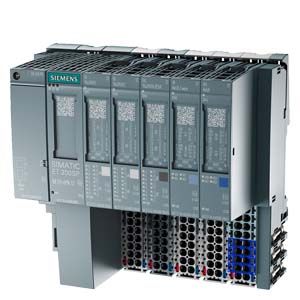
Mounting rail according to EN 60715 | The mounting rail is the module support of the ET 200SP. The ET 200SP is mounting on the mounting rail. |
CPU | The CPU: - executes the user program.
- is used as IO Controller, I-Device on PROFINET IO, or as standalone CPU
- connects the ET 200SP with the IO Devices or the IO Controller
- exchanges data with the I/O modules via the backplane bus
Further functions of the CPU: - Communication via PROFIBUS DP (in combination with the CM DP communication module, the CPU can be used as DP master or slave)
- Integrated Web server
- Integrated technology
- Integrated trace functionality
- Integrated system diagnostics
- Integrated safety
|
Open controller | As the first controller of this type, the SIMATIC ET 200SP Open Controller combines the functions of a PC-based software controller with visualization, PC applications and central I/Os (inputs/outputs) in a single, compact device. - All in one
- High system availability
- Compact and modular
- Rugged
- User-friendly design
- Efficient engineering in the TIA Portal
|
Interface modules for PROFINET IO (IM 155-6PN) | The interface module: - is used as IO Device on the PROFINET IO
- connects the ET 200SP with the IO Controller
- exchanges data with the I/O modules via the backplane bus
|
Interface module for PROFIBUS DP (IM 155-6DP) | The interface module: - is used as DP slave on the PROFIBUS DP
- connects the ET 200SP with the DP master
- exchanges data with the I/O modules via the backplane bus
|
BusAdapter (BA) | BusAdapters permit the free selection of the connection method and connection technology for head-end stations with PROFINET interface. Various versions are available for the connection of copper cables or plastic and glass fiber-optic cables. Hybrid copper/fiber-optic versions are also available as integrated media converters. Cable length between 2 stations:
max.. 100 m (Cu), max. 50 m (POF), max 100 m (PCF), max. 3 km (glass FOC). For expanding the station with the I/O systems ET 200AL via ET-connection, the BusAdapter BA-Send is available. |
BaseUnit (BU) | The BaseUnits provide the electrical and mechanical connection for the ET 200SP components. - Bright BaseUnits permit a new potential group up to max. 10 A
- Dark BaseUnits forward the self-assembling voltage busbars P1, P2 and AUX from the left to the right BaseUnit.
- Suitable BaseUnits with 12 to 28 terminals are available for different connection systems (single or direct multi-conductor connection) and functions.
- The I/O module is plugged onto the desired BaseUnit and determines the potential assignment of the terminals on the BaseUnit.
- For expanding the station with the I/O systems ET 200AL via ET-connection, the BaseUnit BU-Send is available.
|
I/O modules and fail-safe I/O modules | The I/O module determines the function at the terminals. The controller detects the current process state via the connected sensors and triggers corresponding responses via the connected actuators. Some I/O modules feature extended functions, in part they are also designed as individual operating mode. I/O module are divided into the following module types; the fail-safe versions are identified by a preceding “F-” and a yellow module enclosure. - DI (digital input)
- DQ (digital output)
- AI (analog input)
- AQ (analog output)
- TM (technology modules)
- CM (communications modules)
- SM (special modules)
|
Protective cover (BU cover) | The ET 200SP system can be operated with any number of slot gaps (BU slot without I/O module). Applications for this include: - partial commissioning
- prewired, and currently unequipped options
To protect against damage, such slot gaps must be covered by a BU cover. Within the BU cover, an equipment labeling plate can be kept for the possible later use of an I/O module. Versions: - for BaseUnits with a width of 15 mm
- for BaseUnits with a width of 20 mm
|
Server module | The server module concludes the setup of an ET 200SP station. On the server module there are holders for 3 spare fuses (5 ? 20 mm). The server module is included in the scope of delivery of all head-end stations. |
Coding element | When plugging an I/O module onto a BaseUnit for the first time, the coding element moves from the I/O module to the BaseUnit. There it prevents the destruction of the ET 200SP components in the event of a subsequent module replacement with incorrectly selected I/O module. The coding element is available in two versions: - Mechanical coding element
- Electronic coding element:
Additionally features an electronic, re-writable memory for the redundant storage of module-specific configuration data (e.g. F target address for fail-safe modules, parameter data for IO-Link master). Thus these data are automatically backed up during a module replacement.
|
Shield connection | The shield connection permits the connection of cable shields. Compared to external shield supports, the system offers the following advantages: - Quick installation without tools by plugging the shield connection element onto the BaseUnit
- Automatic low-impedance connection to the functional ground (mounting rail)
- Optimized EMC-properties by separating the supply voltage lines from the signal lines by means of the shield connection element and short, unshielded cable lengths
- Low space requirements
|
Labeling strips | Optionally, for system-specific marking the head-end stations and I/O modules can be equipped with labeling strips (13 x 31 mm). The labeling strips can be inscribed mechanically. Labeling strips are available in two versions in the colors light gray and yellow: - 500 strips on the roll, for printing on thermal-transfer printers.
Core diameter 40 mm, external diameter 70 mm, width 62 mm. - 10 DIN A4 sheets with 100 strips each, card 180 g/mm2, perforated, for printing with a laser printer direct from TIA Portal or via print templates.
|
Equipment labeling plate | Optionally, one equipment labeling plate each can be plugged onto head-end stations, BusAdapters, BaseUnits, and I/O modules. Equipment labeling plates are supplied in packs of 10 sheets with 16 labels each. The labels can be printed with thermal-transfer card printers or plotters, or stickers can be attached to them. Advantages compared to labels that are attached directly: - The inscription on the front is not covered
- Simple label replacement when replacing a module
- No parallax errors when marking the BaseUnits on the mounting plate
The size of the inscribable area of the labels is 14.8 x 10.5 mm (W x H) |
Color-coded labels | The I/O modules that are plugged onto the BaseUnits determine the potentials connected at the process terminals. The +/- potentials can optionally be identified using module-specific color-coded labels. The potentials of the AUX and add-on terminals can also be marked using color-coded labels. Advantages of the color-coded labels: - Quick installation (one label for marking 16 terminals)
- Avoidance of wiring errors
- Simple detection of potentials during servicing
|