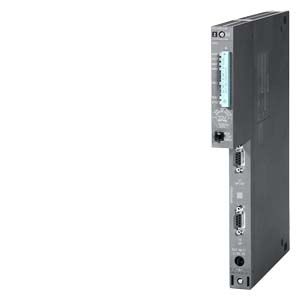
High-performance processor: The CPUs achieve instruction execution times as low as 0.03 µs per binary instruction.
CPU 416F-2: 8 MB main memory (of which 4 MB each for program or data); CPU 416F-3 PN/DP: 11.2 MB main memory (of which 5.6 MB each for program or data); fast main memory for parts of the user program that are significant for execution.
Flexible expansion possibilities: Max. 262144 digital, 16384 analog inputs/outputs
MPI multi-point interface: With the MPI it is possible to establish simple networking of max. 32 stations at a data transmission rate of up to 12 Mbps. The CPUs can establish up to 44 connections to stations of the communication bus (C bus) and the MPI.
Mode selector: Toggle switch design
Diagnostics buffer: The last 120 error and interrupt events are stored in a ring buffer for diagnostic purposes. The number of entries can be parameterized.
Real-time clock: Diagnostic alarms of the CPU are tagged with the date and time.
Memory card: To expand the integrated load memory. RAM and FEPROM cards (FEPROM for saving even at zero voltage).
Combined MPI/DP interface and integrated PROFIBUS DP interface (with CPU 416F-2): The PROFIBUS DP master interface allows a distributed automation configuration offering high speed and ease of use. The distributed I/O is treated like a central I/O from the point of view of the user (same configuring, addressing and programming). Mixed installation: SIMATIC S5 and SIMATIC S7 as PROFIBUS master acc. to EN 50170.
CPU 416F-3 PN/DP also features:
Submodule socket: Using the IF 964-DP interface module, an additional PROFIBUS DP master system can be connected.
PROFINET interface with 2 ports (switch):
PROFINET IO, 256 IO devices can be connected
PROFINET CBA
Failsafe I/O modules can be connected to all integrated interfaces, to IF 964-DP and/or via communication modules (CP443-5 Ext. and CP443-1 Advanced). Safety-related communication is performed over PROFIBUS DP with the PROFIsafe profile.