


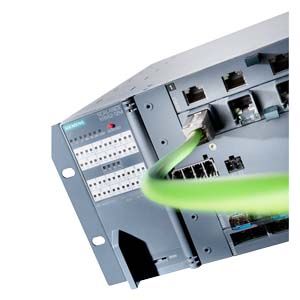
Network performance and network technologies with Industrial Ethernet When combined, the current Industrial Ethernet technologies can significantly boost performance on the network in comparison with the original 10 Mbps technology. These technologies are:
Ethernet Switching The Industrial Ethernet switch has the following functionality:
The switching technology offers definite advantages:
Full duplex Full duplex (FDX) is an operating mode in the network that, in contrast to half duplex, allows stations to send and receive data simultaneously. When FDX is used, collision detection is automatically deactivated in the participating stations. For FDX, transmission media with separate send and receive channels must be used, e.g. FOC and TP, and the participating components must be able to store data packages. With an FDX connection collisions do not occur, so components that support FDX can send and receive simultaneously at the nominal transmission rate. The data throughput therefore increases to twice the nominal transmission rate of the network, to 20 Mbps with the classic Ethernet and 200 Mbps with Fast Ethernet. With Gigabit Ethernet, up to 2000 Mbps are achieved. A further advantage of FDX is increased network size. By deactivating the collision principle, the distance between two components can be increased by the size of a collision domain or more. With full duplex, the maximum distance can extend as far as the performance limit of the send and receive components. This is especially the case in connection with fiber-optic cables. When glass fiber-optic cables are used, distances of up to 200 km can be achieved between two switches.  Increased performance through switching, full duplex Autosensing/autonegotiation Autosensing describes the characteristic of network nodes (data terminals and network components) that automatically detect the transmission rate of a signal (10 Mbps, 100 Mbps or 1000 Mbps) and support autonegotiation. Autonegotiation is the configuration protocol for Twisted Pair. It enables the participating nodes to negotiate and agree the transmission rate before the first data packages are transferred:
Autonegotiation can also be deactivated if a specific transmission rate has to be defined. The advantage with autosensing lies in the interoperability of all Ethernet components. Autocrossover The autocrossover function automatically crosses the send and receive cables on twisted pair interfaces. This means that crossed connecting lines (e.g. TP XP cords) are no longer required. High Speed Redundancy Protocol (HRP) Extremely fast reconfiguration of the network following an error is indispensable for industrial applications, because the connected data terminals will otherwise disconnect logical communication links. This would result in a process running out of control or emergency shutdown of the plant. In order to achieve the very fast reaction times required, various standardized procedures are used. A network can then be reconfigured to form a functional network infrastructure again in a fraction of a second. In an optical ring comprising 50 switches, the network will be reconfigured after a fault (cable break or switch failure) in less than 300 ms. In addition to implementing high-speed media redundancy in the ring, Industrial Ethernet switches also offer the functions required for high-speed redundant coupling of rings or network segments. Rings or network segments in any topology can be coupled via two switches in each case.  Configuration with high-speed redundancy in the optical ring  Configuration with high-speed redundancy in the electrical ring Media Redundant Protocol (MRP) A further option for attaining greater system availability is PROFINET MRP. The media redundancy can be created on the one hand by means of switches, and on the other hand direct via the PROFINET interfaces on SIMATIC controllers and distributed inputs/outputs. Thanks to the MRP protocol (IEC 61158 Type 10), reconfiguration times of less than 200 ms can be achieved, depending on the number of stations. If the ring is interrupted at one point, immediate reconfiguration takes place and all communication nodes continue to be accessible.  Electrical/optical ring topology with SCALANCE X101-1/X101-1LD  Optical star topology with SCALANCE X101-1/X101-1LD and remote SCALANCE W Access Point Seamless redundancy For some applications with particularly high requirements in terms of the reconfiguration time, there is the possibility of setting up a redundant network without any reconfiguration time at all (seamless redundancy). For this purpose, PROFINET offers the MRPD standard (Media Redundancy for Planned Duplication). This method is based on the topology-optimized IRT communication. Two other solutions that can be used are High-availability Seamless Redundancy (HSR) and Parallel Redundancy Protocol (PRP) of the IEC 62439-3 standard. All methods facilitate networks that continue to function in the event of a fault (e.g.: cable break) WITHOUT interruption. This is achieved by duplicating the data packets at the sender and then transmitting them to the recipient over two different paths.  Bumpless, parallel networks with PRP redundancy procedure  Bumpless, ring-shaped network with HSR redundancy procedure Redundancy with the Spanning Tree algorithm The Spanning Tree algorithm is described in the IEEE 802.1D standard; it organizes any number of meshed Ethernet structures comprising bridges and switches. To prevent data packages circulating in the network, different connections in the case of closed meshes are switched to standby so that an open tree structure results from the meshed structure. For this purpose, switches communicate with each other using the Spanning Tree Protocol. This protocol is extremely complex because it has to handle any type of network structure. The organization of network structures with the Spanning Tree protocol can take from 30 to 60 seconds. During this period, productive communication for reliable visualization or process control in the network is not possible. In the time-optimized variant "Rapid Reconfiguration Spanning Tree" according to IEEE 802.1, the time is shortened to between 1 and 3 seconds for up to 10 series-connected switches. Due to the comparatively long reconfiguration time, this protocol is used predominantly in office networks. For connecting to such office networks, some SIMATIC NET switches support the Rapid Spanning Tree Protocol. Switched Network Switched industrial networks can be configured electrically or optically with a linear, star or ring structure, or a combination. They are constructed with SCALANCE X switches and with switches integrated into terminal devices, e.g. in communication processors. Electrical cables (e.g. twisted pair cables) or fiber optic cables are used as the transmission medium between the switches and for connection to the terminal devices electrical cables (e.g. twisted pair cables). Switched networks can be of any size. In networks of a larger scale, the signal delays are to be considered (depending on the application). Optical cabling with POF/PCF or glass fiber-optic cable Fiber-optic cables are always recommended as an alternative to copper cables in environments subject to strong electromagnetic interference (EMI) if reliable equipotential bonding cannot be guaranteed, or if the system is in the open air. Glass fiber-optic cables are used for data transmission over long distances, while for shorter distances, plastic fiber-optic cable made of light-conducting plastics like polymer optical fiber (POF), or plastic covered glass fibers such as polymer cladded fiber (PCF), are used. Simple fiber-optic cabling for machine-level use is implemented with the SC RJ connection system for polymer optical fiber and PCF. The SC RJ connectors can be assembled especially quickly and easily on-site. The plastic fiber-optic cables designed for this purpose can be used universally or specifically in festoon cable systems. For optical cabling, e.g. for a PROFINET system, products with POF or PCF connection are used, e.g. the SCALANCE X200-4P IRT Industrial Ethernet Switch or ET 200S distributed I/O devices.  Mixed network with SCALANCE X202-2P IRT and SCALANCE X101-1POF media converter High-availability communication The availability of communication is increased by means of redundant communication connections to which the data transmission can be switched quickly in the event of a fault. High-availability S7 connections can be set up from S7-400H stations to:
.  Increased availability by means of redundant communication connections Gigabit on the control level Whereas in the field level, short response times and small data message frames are in the forefront, the need for high data throughput is constantly increasing on the control level. The reason for this is the rapidly growing number of nodes and data-intensive systems such as HMI, SCADA, code reading systems, web applications or multimedia applications. In addition to the Gigabit-capable network infrastructure, there are also Gigabit-capable system connections for PCs or SIMATIC S7-300/400/1500. The CP 1623 communications processor for PCI Express supports a high-performance connection of the HMI/SCADA systems and simultaneously increases the reliability of the network by means of an optional external power supply. The CP 343-1 Advanced and CP 443-1 Advanced communication processors for SIMATIC S7-300/400 implement integral network separation between the control level and field level and provide:
 Network separation between field level and control level including gigabit communication at the control level Network separation between field level and control level Networks often have to be separated physically from one another, but nevertheless have to communicate with one another. Reasons for network separation are deliberate load decoupling or different responsibilities within an enterprise (e.g. office and production network). It is easy to meet this requirement when using the CP 343-1 Advanced and CP 443-1 Advanced communication processors for S7 controllers. With the introduction of interfaces for separate IP subnetworks in Gigabit Ethernet and Fast Ethernet on one module, the cross-network use of IT services is possible by means of static IP routing. A firewall protects programmable controllers against unauthorized access regardless of the size of the network to be protected. As an alternative or supplement, secure authentication of the communication partners and encryption of the transmitted data can be handled via a VPN (Virtual Private Network). SIMATIC PCS 7 process control system with Gigabit In the control room, two SCALANCE X-400 switches are used on the terminal bus. If a high number of nodes are connected to the plant bus, SCALANCE XR-500 or XM-400 switches, for example, can be used with port extenders. These are connected together to create an electrical ring with a transfer rate of 1 Gbps. Several operator panels are provided and divided between the two switches so that the system can still be operated in the event of a failure. The terminal and plant buses are connected using redundant servers, e.g. with SCALANCE X408-2 also via high-performance Gigabit lines.  Use of SCALANCE X switches in a process control system, e.g. PCS 7  Plant network with connection to the management level or the corporate network with SCALANCE X-500 Fail-safe wireless communication with PROFIsafe For several years, safety engineering has been integrated into standard automation on the basis of SIMATIC S7 controllers, PROFIBUS and PROFIsafe. This range has been expanded by PROFINET-enabled components, thus providing a complete product range with failsafe controllers, failsafe I/O and a corresponding engineering environment. PROFIsafe prevents errors such as address corruption, loss, delay, etc. when transmitting messages through continuous numbering of the PROFIsafe data, time monitoring, and authenticity monitoring using passwords and optimized cyclic redundancy checks (CRC).  Fail-safe wireless communication with PROFIsafe Coupling of networks For high-performance coupling of networks, the modular Industrial Ethernet Switch SCALANCE XM-400 is available. With SCALANCE XM-400, high-speed IP routing permits communication between different IP subnetworks and routers. Methods supported for this include:
 High-performance Layer 3 switching paired with redundant routing (VRRP) |
| Каталог 2018 | Каталог 2017 | Каталог 2016 | Каталог 2015 | Каталог 2014 | Каталог 2013 | Каталог 2012 | Сертификат | Контакты | Карта сайта | Поиск |